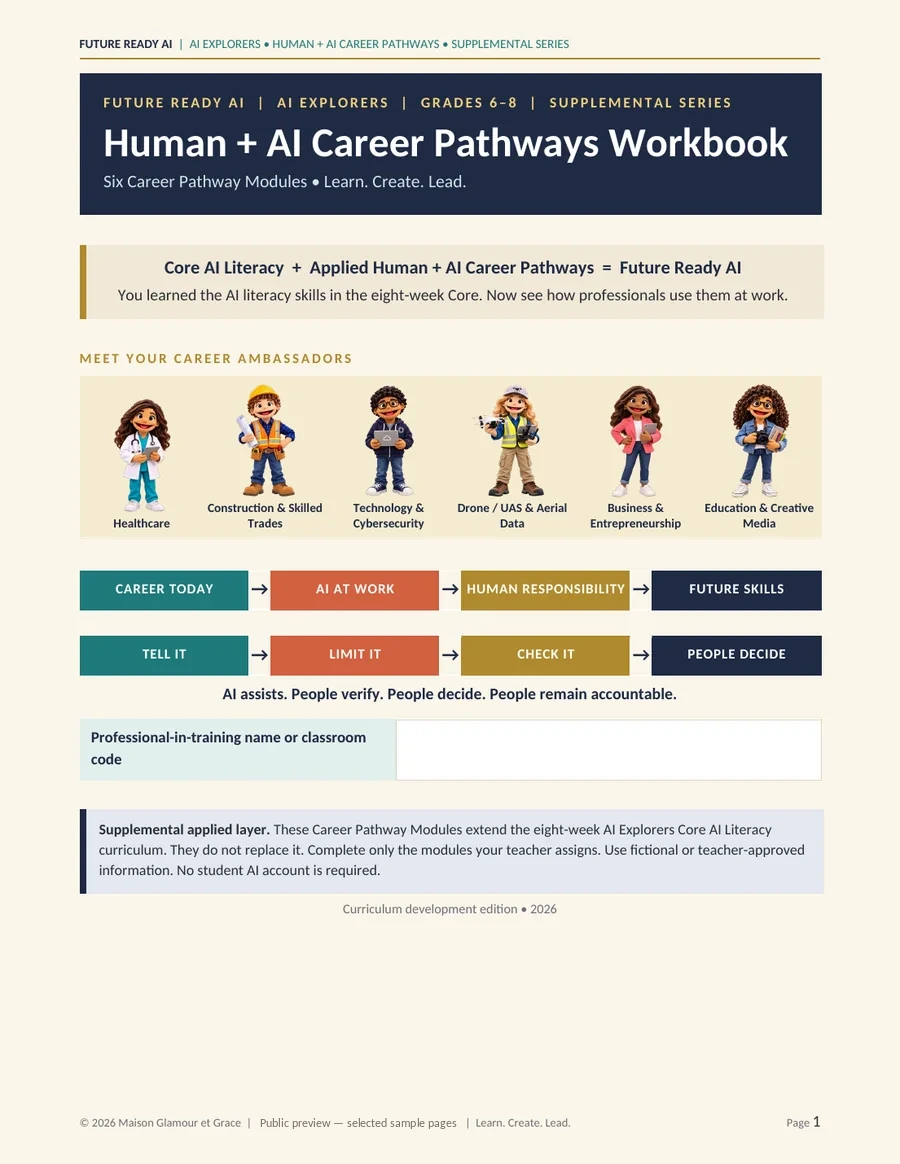
Future Ready AI · AI Explorers · Grades 6–8 · one workbook in the series
Human + AI Career Pathways
Students explore where AI can assist, what people must verify and which decisions remain human across careers and industries.

Education & School Partnerships
School, district and college partnerships connecting learning with opportunity. Future Ready AI (grades 3–12) and Drone Career Explorer (grades 6–12) give students hands-on learning in AI literacy and drone technology, with workbooks, video lessons and FAA Part 107 knowledge test preparation.
UAS • Curriculum • Career readiness
Drone Career Explorer is one connected path: students start in middle school, go deeper in high school, and, once eligible (age 16 or older), prepare for the FAA Part 107 knowledge test, with an advanced pathway for Part 108 and BVLOS readiness.
 Explore the curriculum ↗
Step 1 · Grades 6–8 · 2 min 14 sec · open captions
An engaging introduction to drone technology: how drones work, flying safely and responsibly, planning a mission, and the careers that use these skills.
Middle school pathway ↗Step 2 · Grades 9–12 · 2 min 14 sec · open captions
Students apply the system: mission analysis, AI, sensors and data, industry applications and workforce readiness, ending with a capstone mission proposal.
High school pathway ↗Covers and selected pages
Covers and selected pages from our human-centered curriculum and drone workbooks. Full workbooks, teacher guides and answer keys are provided to partner schools and programs.
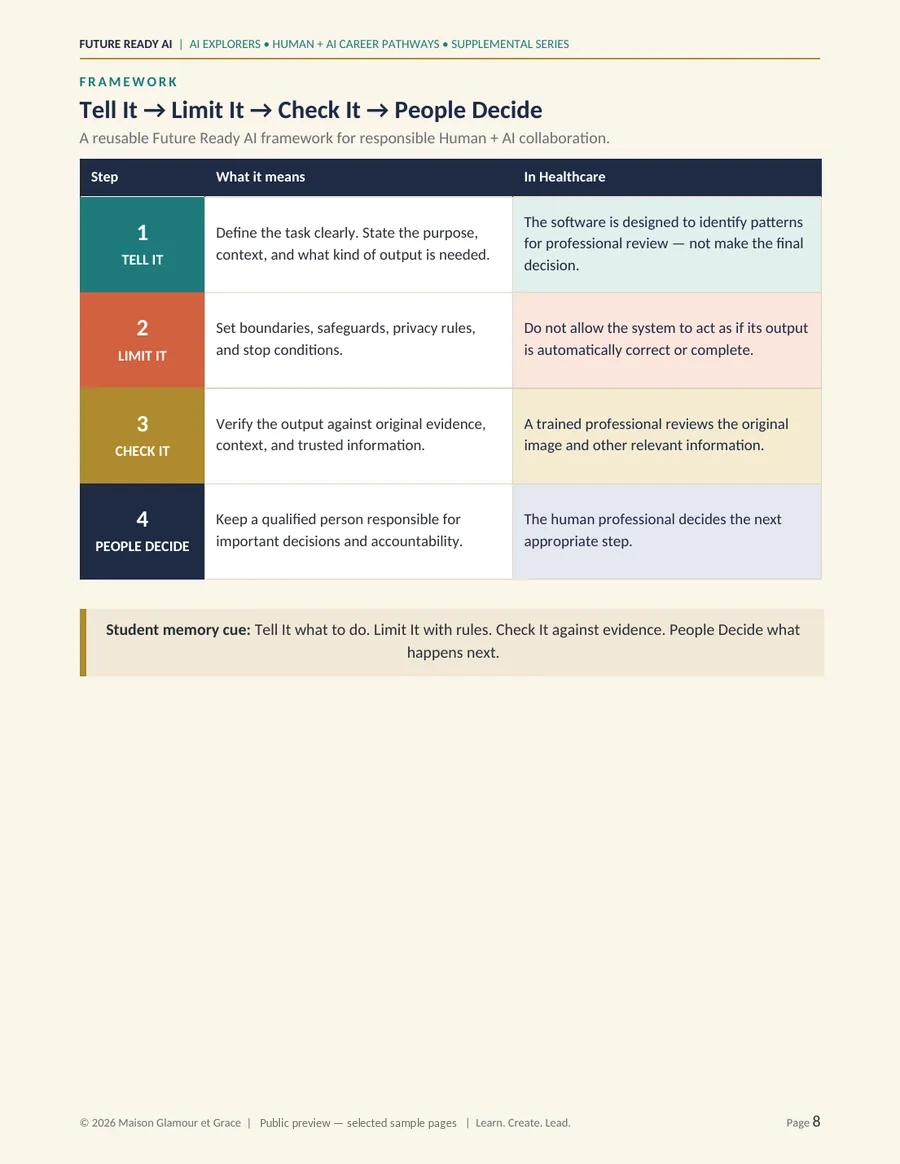
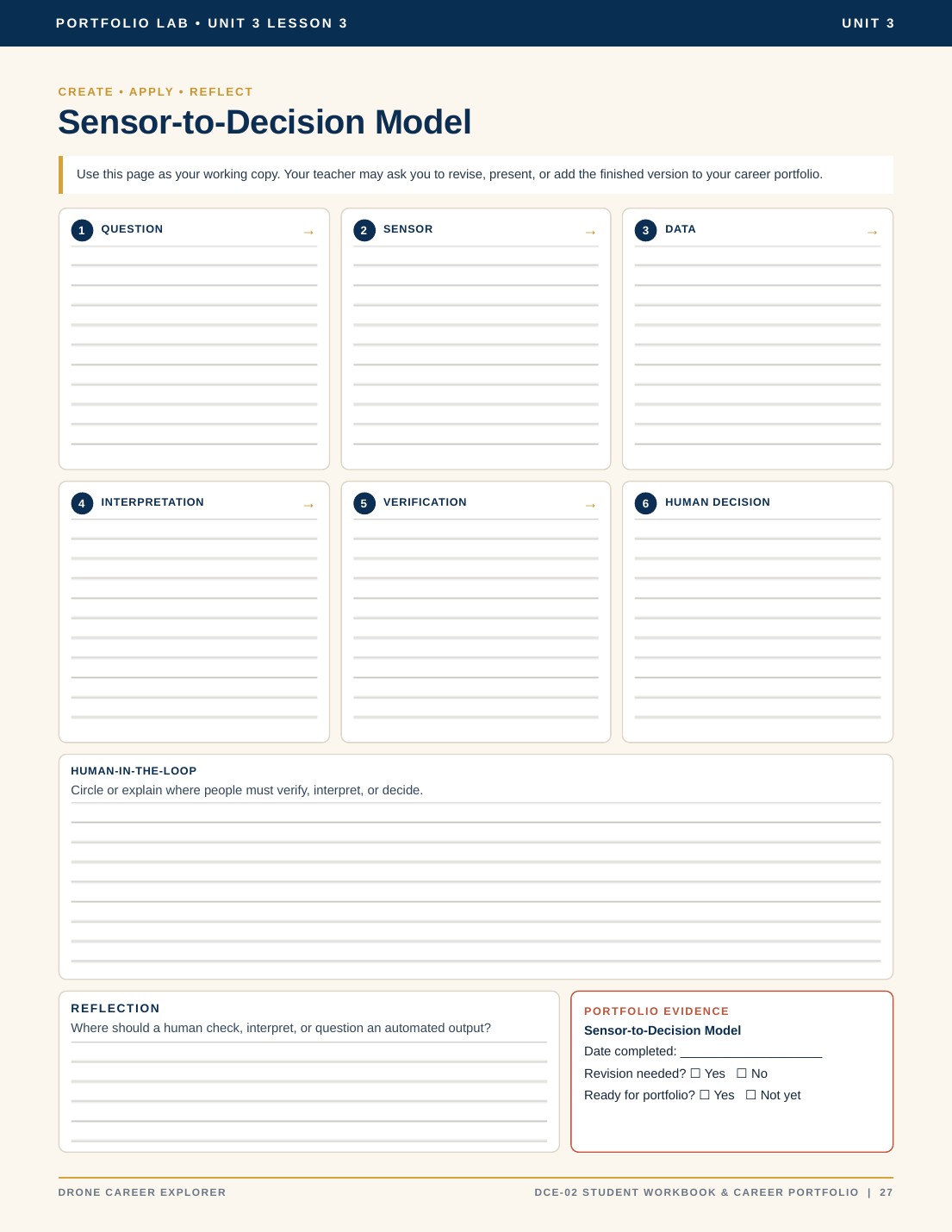
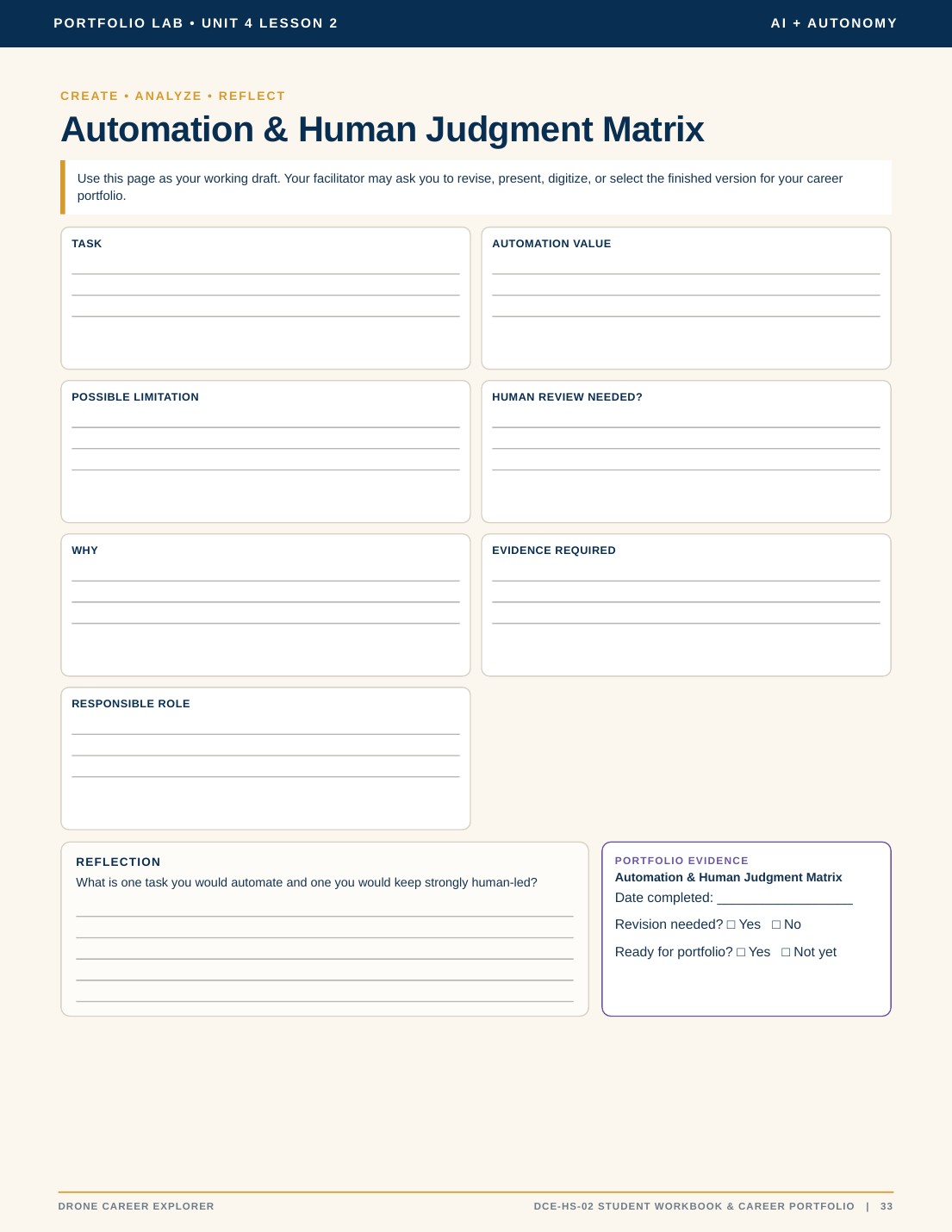
Future Ready AI · AI Explorers · Grades 6–8 · one workbook in the series
Students explore where AI can assist, what people must verify and which decisions remain human across careers and industries.
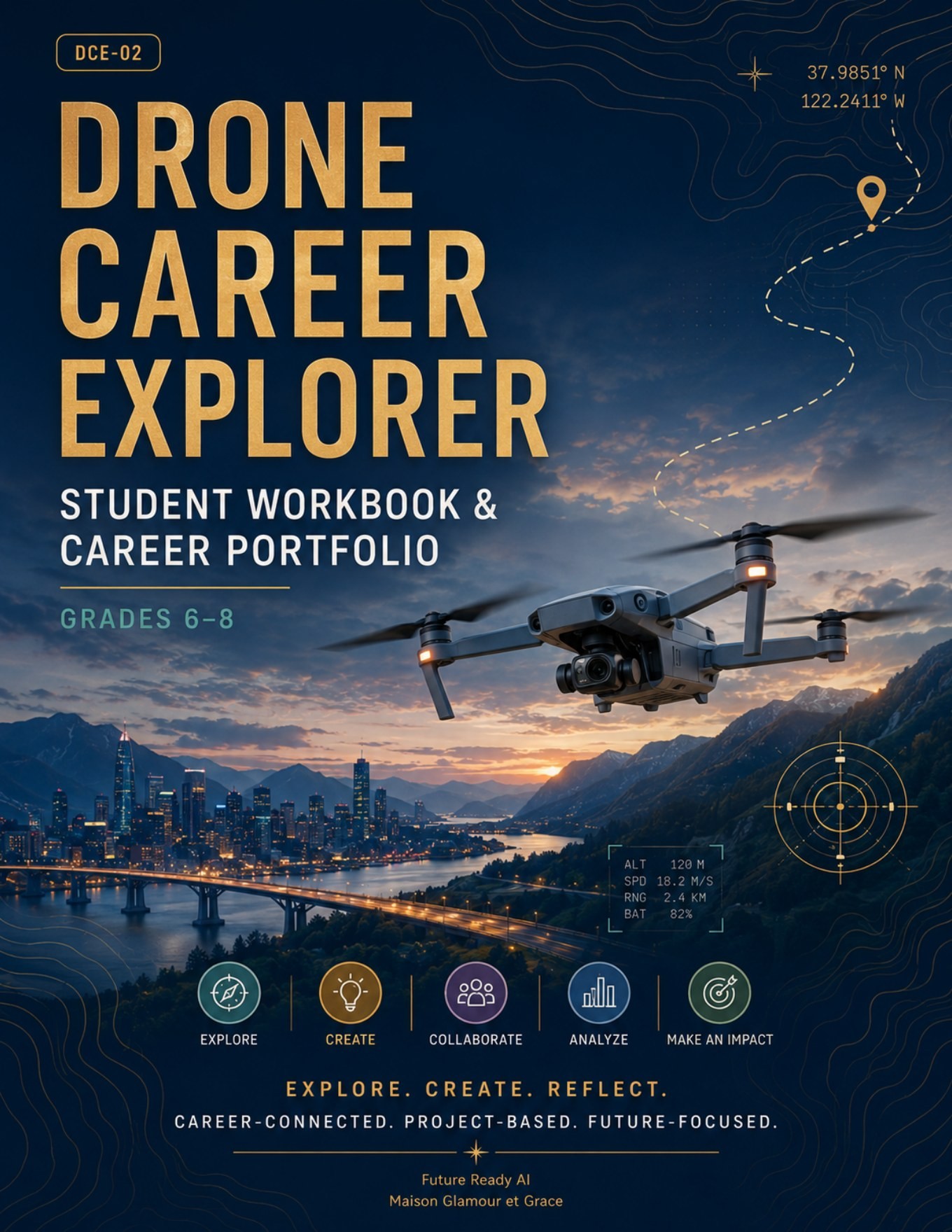
Drone Career Explorer · Grades 6–8
Student Workbook & Career Portfolio. Students build systems thinking, responsible use, mission planning and career awareness.
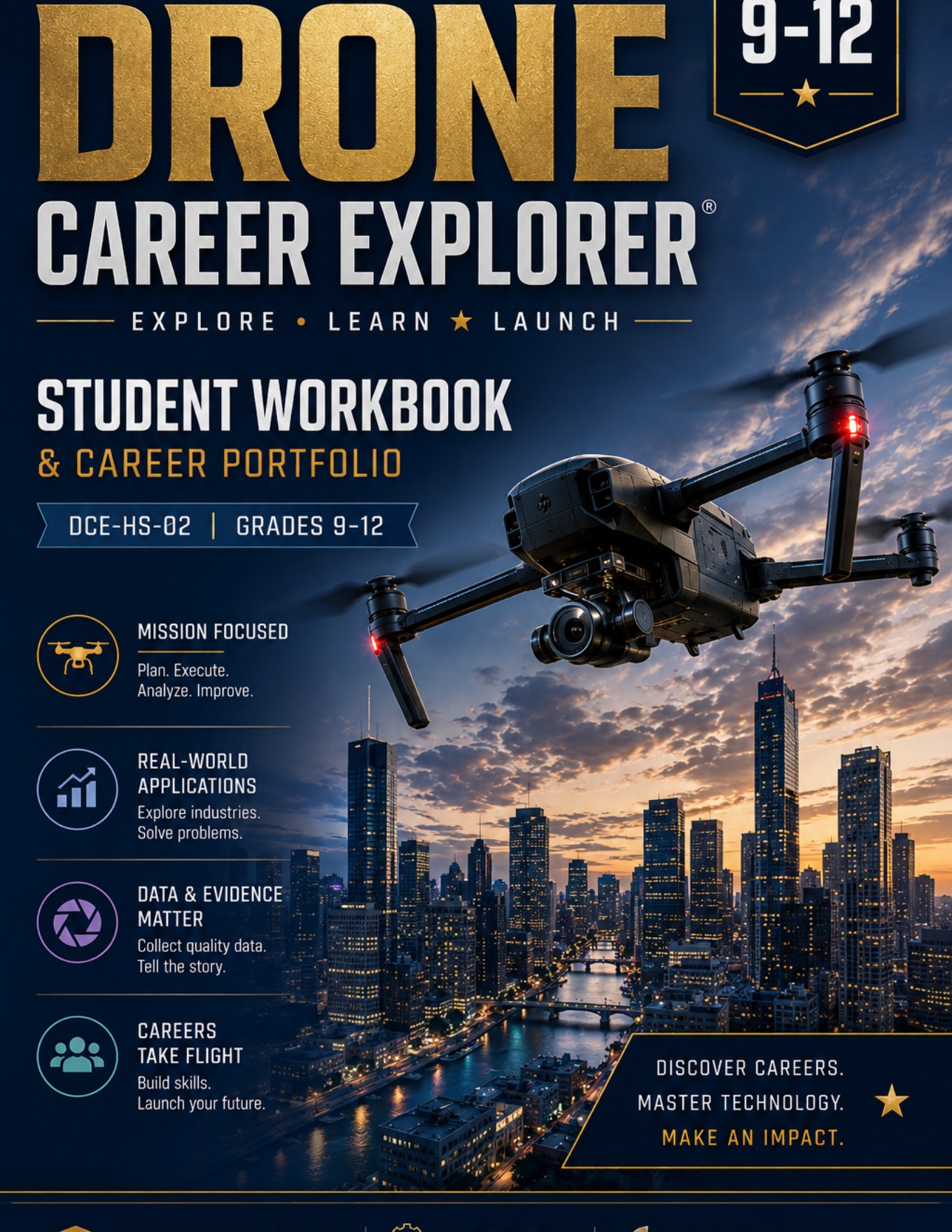
Drone Career Explorer · Grades 9–12
Students connect technical analysis, responsible decision-making, industry applications and career readiness.
Remote pilot prep · advanced operations
Step 3 · Remote pilot prep
Mission-based preparation for the FAA Part 107 knowledge test: the regulations, airspace, weather, loading and performance, and operational decisions behind the FAA Remote Pilot Certificate.
The FAA issues the Remote Pilot Certificate to applicants who are at least 16, pass the knowledge test and complete FAA and TSA vetting. Learn about Part 107 on the FAA site ↗
Step 4 · Advanced operations
BVLOS means flying a drone beyond visual line of sight. The FAA’s proposed Part 108 rule would create a standard framework for these operations, which today generally require an FAA waiver or exemption approved case by case. Our Part 108 BVLOS Operator Readiness pathway helps professionals and organizations prepare for the operating, safety, data and human-oversight systems the proposal describes.
Proposed rule · not yet in effectStatus as of October 24, 2026: Part 108 is a proposed rule, not law. The FAA and TSA published the proposal on August 7, 2025, and the final rule has been under White House review since July 10, 2026. It has not been published. This pathway is proposed-rule readiness education and will be revised when final requirements are published. Proposed rule (Federal Register) ↗ · Docket FAA-2025-1908 ↗ · What Part 108 could mean
Roles, records, procedures and accountability.
Risk management, reporting and responsible oversight of automation.
Information handling, communications and operational resilience.
Fourteen modules in four phases, ending with industry applications and a readiness capstone. Materials are provided to partner organizations and participants, not published publicly.
Proposed-rule readiness edition. Educational readiness only. Completing this pathway does not constitute FAA certification, operating authority, a permit, certificate, waiver or any other authorization to conduct BVLOS operations. Current pathways, including Part 107 waivers and Part 135 package-delivery certification, are separate.
Next step
Drone learning can lead to further exploration of aerial data, mapping and GIS.
Future Ready AI · Learn. Create. Lead.
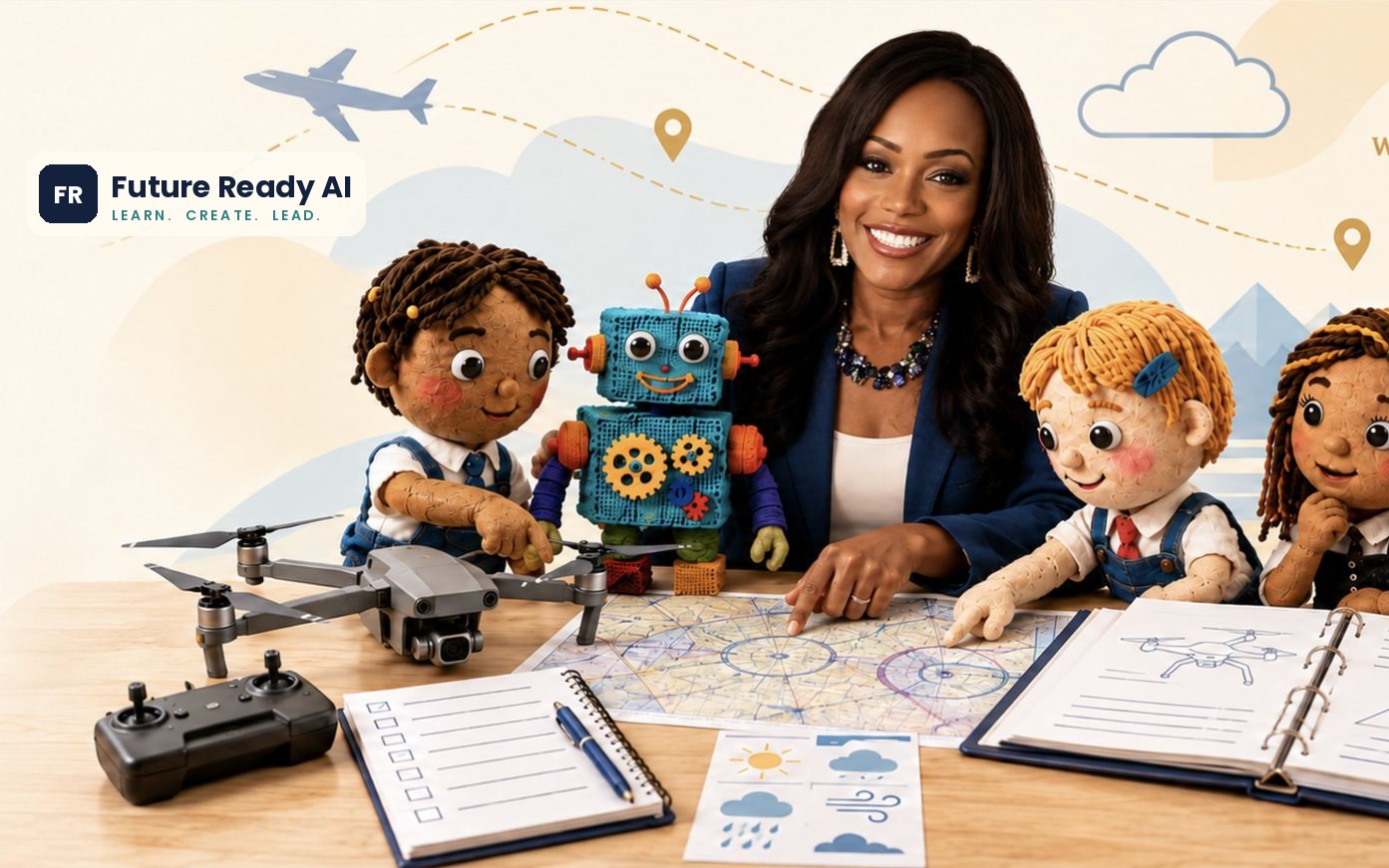
Future Ready AI introduces students in grades 3–12 to artificial intelligence, responsible technology use, digital literacy, critical thinking and emerging career possibilities.
The program provides developmentally appropriate, project-based experiences that help young learners understand technology and apply concepts thoughtfully.
 View the curriculum ↗
Future Ready AI
AI literacy that grows with every learner.
Created by Andrea Davis-Baptiste
Elementary
Grades 3–5 · Six weeks
Notice · Protect · Check · Create
Students explore patterns, classification and everyday AI, practicing safe technology use, simple verification and creativity.
Middle school
Grades 6–8 · Eight weeks
Analyze · Audit · Verify · Evaluate · Design
Students examine how AI uses data and patterns, strengthen prompting and verification, and spot bias and privacy risks.
High school
Grades 9–12 · Nine weeks
Research · Design · Solve · Lead
Students investigate bias, fairness and synthetic media, then design responsible solutions tied to real careers.
Eligible older students may also take part in supplemental credential-readiness experiences through school or workforce partnerships. About credential preparation
For educators & school leaders
Professional learning for educators implementing Future Ready AI, focused on practical AI use, responsible decision-making and classroom implementation.
Topics include
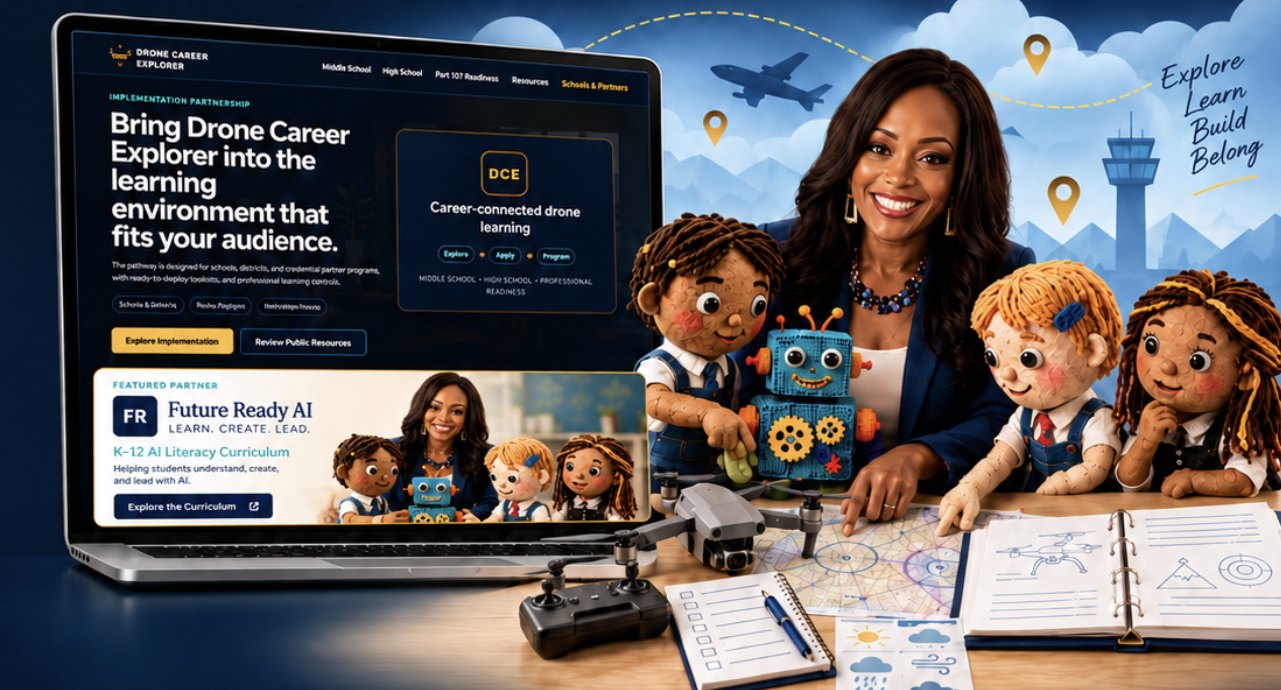
Schools, districts and partner programs get ready-to-use toolkits, educator professional learning and a career-connected drone pathway, alongside Future Ready AI for AI literacy in grades 3–12.
A small program or project to test fit and results.
Professional learning for teachers and staff.
Workforce programs and career pathways for more learners.
Real aerial or mapping projects as capability grows.
For districts
Maison welcomes school and district partners interested in piloting age-appropriate AI literacy, drone career exploration and emerging technology education. Pilot objectives, educator support, schedules, privacy protections and evaluation measures are established with each participating school or district.
Accepting pilot partnership inquiriesGrades 6–12: career exploration, foundational drone terminology, career pathways and applied activities using the existing curriculum materials. Exact length is confirmed against finalized lessons.
Hands-on flight activities are planned separately with each school, with appropriate supervision and safety measures.
Materials may include:
Future Ready AI is designed around:
Every implementation also follows the partner district’s approved technology, privacy, accessibility and instructional policies.
Responsible AI, educator productivity, technology integration, train-the-trainer and drone career pathways sessions, from 90-minute introductions to multiweek support.
School districts, colleges, universities, workforce boards and community programs exploring AI, drones, GIS and career pathways.
Construction firms, aviation organizations, GIS groups, drone companies and industry associations.
Public agencies and community groups focused on access, training and economic opportunity.
Possible engagement formats we can explore with partners:
Higher education
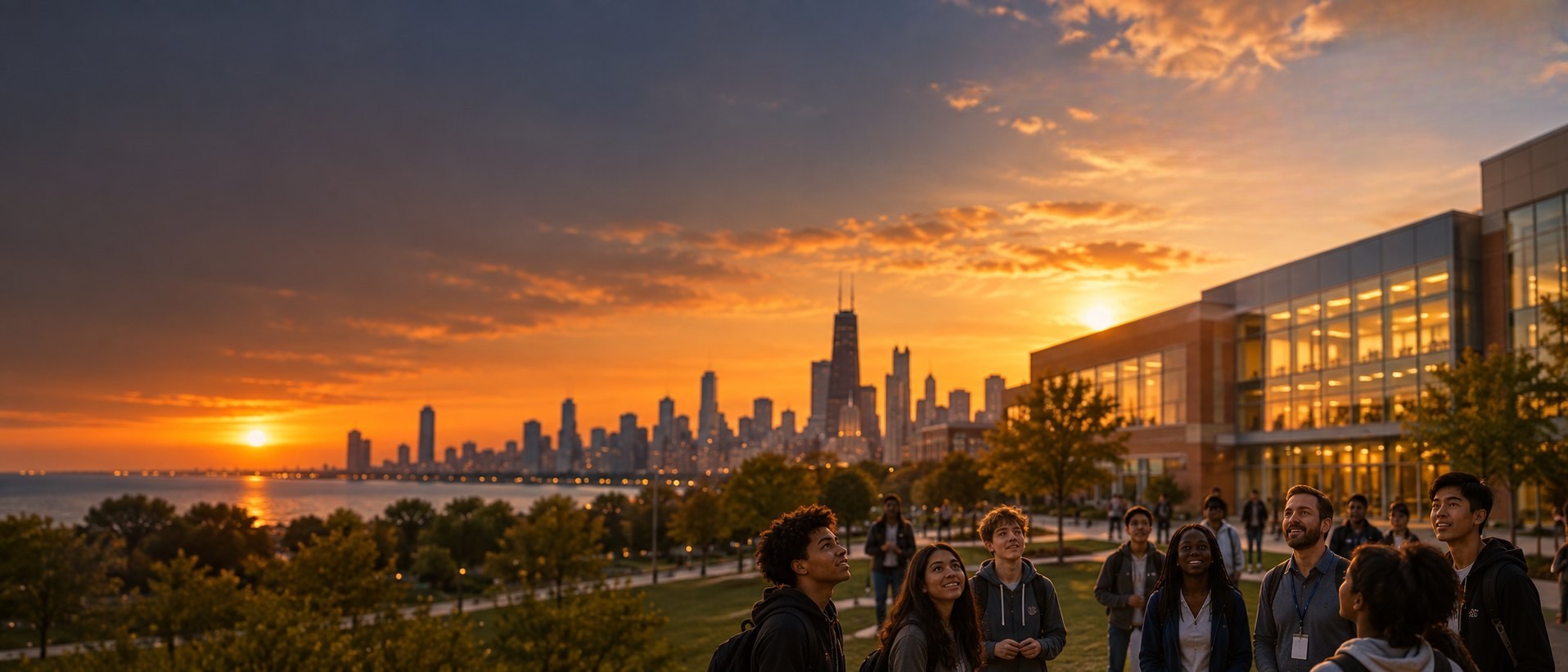
Maison Glamour et Grâce welcomes conversations with colleges, universities and community colleges, including Historically Black Colleges and Universities (HBCUs), interested in connecting student learning, entrepreneurship and emerging technology with practical business opportunities.
We look forward to collaborations that create meaningful opportunities for students, faculty, adult learners and campus workforce programs.
Student projects in marketing, creative production, business operations, AI and drone applications.
Faculty collaboration on applied learning and career readiness, and AI and emerging technology workforce readiness for students and adult learners.
Entrepreneurship-center connections, mentorship and business development support.
Portfolio-building projects tied to practical business needs, plus drone career exploration and preparation for external credentials such as the FAA Part 107 knowledge test.
Tell us about your department, students and goals.
Agree on a project, course tie-in or event that fits the term.
Students and faculty work on real business needs with Maison.
Tell us about your learners and we’ll suggest the right first step.